
If you live in Chennai, you already know what happens every monsoon. The roads get resurfaced, the level goes up by a few inches, and your house sits a little lower than it did last year. Give it five or ten years, and your front door is two feet below the road. Rainwater walks right in. The sewage line backs up. The walls stay damp for months.
This isn’t a hypothetical problem. It’s happening right now in Velachery, Mudichur, Tambaram, Adyar, Sholinganallur, Perumbakkam, Porur, and Pallikaranai — some of Chennai’s most populated residential areas. After the devastating 2015 floods, thousands of homeowners realised that patching the problem with temporary barriers and pump-outs was never going to work.
So what actually works? Building lifting services in Chennai have helped thousands of homeowners raise their homes to a safe height above the road — without demolishing a single wall.
At Home Lifting India, we’ve been doing exactly this for over 20 years using manual screw jack technology. Over 5,000 projects across 25+ states. And Chennai is one of the cities where we see the highest demand, for obvious reasons.
This guide covers everything you need to know: how building lifting works, what it costs in Chennai, how our process keeps your structure safe, and how to decide whether lifting is the right solution for your home.
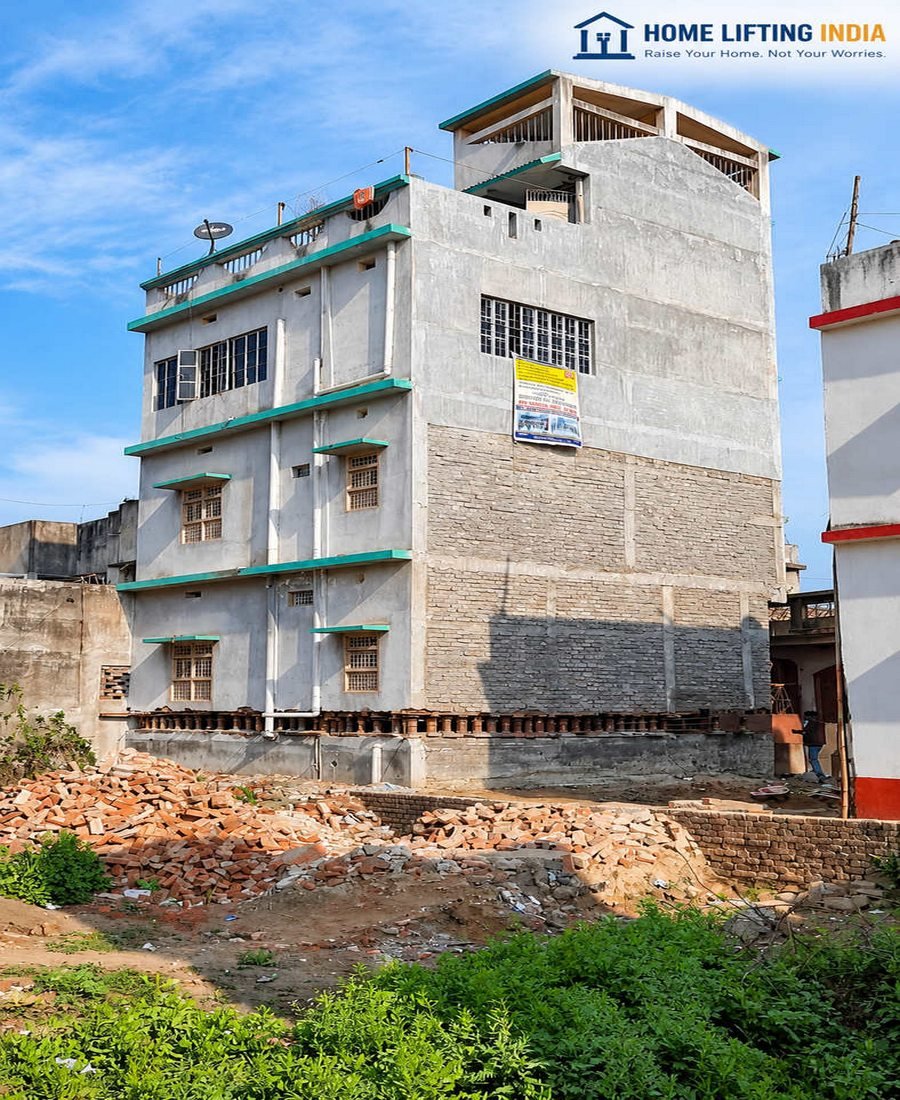
Why Chennai Homeowners Need Building Lifting Services
Chennai sits on a flat coastal plain, barely above sea level in most areas. That geography, combined with rapid urbanisation, creates a specific set of problems that building lifting solves.
Roads go up, houses stay put. Every time Chennai Corporation or the highways department resurfaces a road, it adds 2–4 inches. Over 10–15 years, a house that was once level with the road is now sitting 2–3 feet below it. This is extremely common in areas like T. Nagar, Choolaimedu, Anna Nagar West, and Ambattur.
Flooding is not a one-time event. Chennai’s northeast monsoon dumps heavy rain every year. Low-lying houses in Velachery, Mudichur, and Pallikaranai don’t just flood during extreme weather — they flood every single monsoon season. The 2015 floods were a wake-up call, but the annual waterlogging is the real, ongoing problem.
Sewage and drainage backflow. When your house is lower than the municipal drain line, sewage doesn’t flow out — it flows back in. This is a health hazard, and no amount of plumbing work fixes it when the root cause is the house sitting below drain level.
Sinking foundations. Chennai’s soil varies dramatically — from sandy coastal soil in areas near the beach to heavy clay in inland neighbourhoods. Some houses settle unevenly over decades, causing cracks, tilting, and structural weakness.
If your house is already tilting or settling unevenly, our house leveling services can correct it before the damage gets worse.
Property value drops. A house below road level in Chennai can lose 20–30% of its market value. Buyers see waterlogging stains, damp walls, and a sunken entrance and walk away.
The common thread? All of these problems have one permanent fix — lifting the building above road level. Not a band-aid. A structural solution.
Not sure if building lifting is right for your home? Get a free site assessment — our engineers will inspect and advise at no cost.
What Is Building Lifting and How Does It Work?
Building lifting is exactly what it sounds like — raising an existing building from its current level to a new, higher level. The entire structure goes up: walls, roof, floors, everything. Nothing is demolished. Nothing is rebuilt from scratch.
The building sits on its foundation. We place jacks underneath the structure at calculated points, and raise it slowly and evenly — a few millimetres at a time — until it reaches the required height. Then we build a new, stronger foundation underneath and set the building down on it.
That’s the simple version. The engineering behind it is more involved, but from a homeowner’s perspective, the result is straightforward: your house goes up, the water stays out, and you don’t lose your home in the process.
Building lifting vs house lifting — is there a difference?
People use these terms interchangeably, and that’s fine. Technically, “house lifting” usually refers to residential structures (individual homes, 1–2 floors), while “building lifting” covers larger structures — multi-storey apartments, commercial buildings, shops, and godowns. The process is fundamentally the same; the scale and engineering complexity change.
We handle both. Whether you need house lifting services in Chennai for a single-storey home in Tambaram, or building lifting for a G+2 commercial structure in Guindy, the approach follows the same engineering principles. You can read the full house lifting process on our blog for a deeper look at what happens on site.
The question every homeowner asks: “Will my house crack?”
This is the number one concern, and it’s completely valid. The answer depends entirely on two things: the structural condition of your building, and the method used to lift it.
A properly assessed building, lifted with the right technology at the right speed, does not crack. We’ve completed over 5,000 projects, including houses that were 40–50 years old, and delivered them without structural damage. The key is the technology and the team behind it — which brings us to the next section.
Manual Screw Jack Technology — The Safer Way to Lift Buildings
This is what sets us apart from every other building lifting company in Chennai.
Most companies use hydraulic jacks. They’re fast, they’re powerful, and they get the job done — but fast and powerful isn’t always what a building needs. Hydraulic jacks apply force quickly, and if the pressure isn’t perfectly balanced across every jack at every moment, you get uneven lifting. Uneven lifting causes cracks.
We use manual screw jacks. Here’s why that matters.
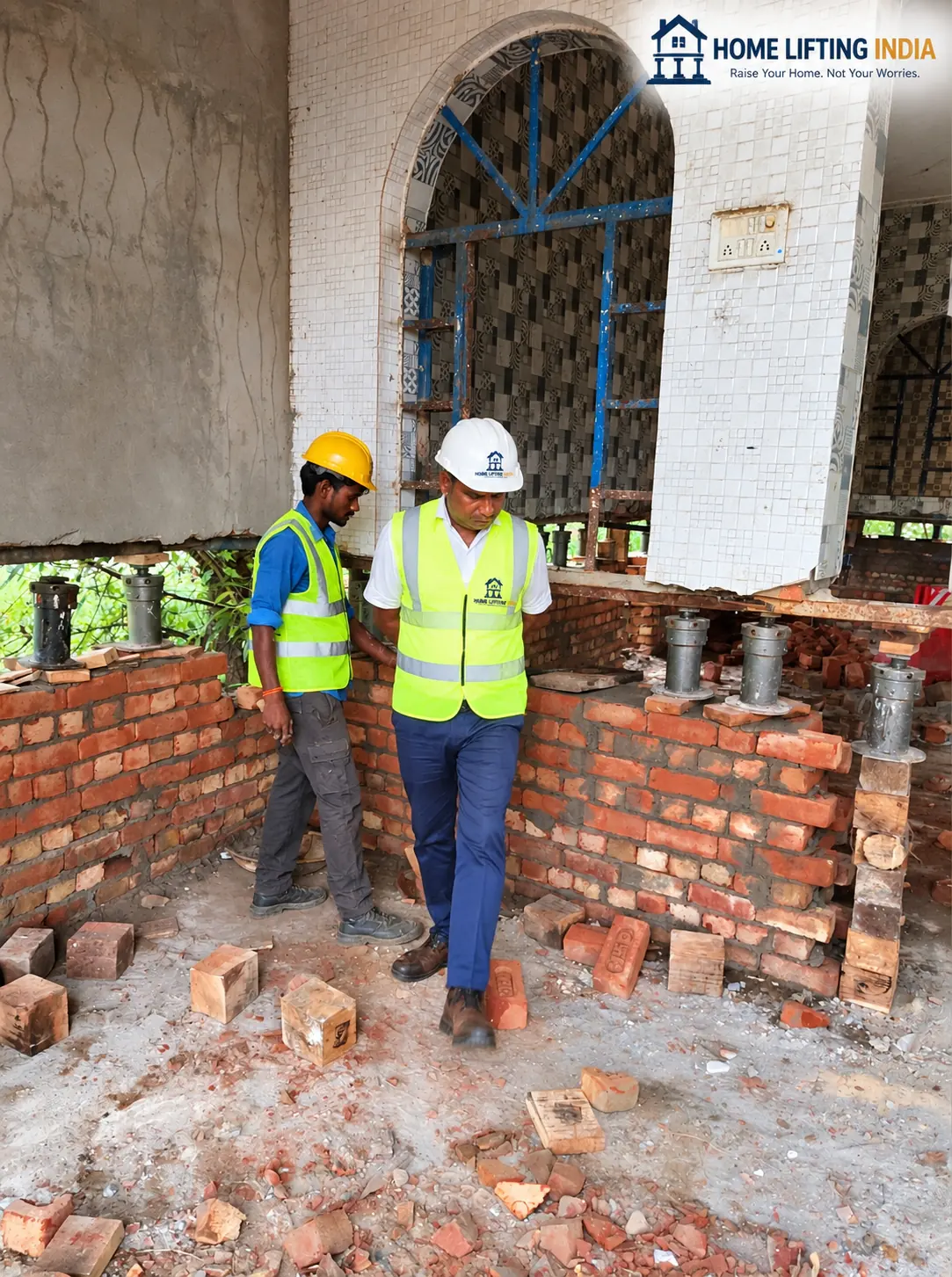
How manual screw jacks work: A screw jack is a simple mechanical device — a threaded rod turned by hand using a lever. Each turn raises the jack by a precise, small amount. There’s no motor, no hydraulic fluid, no sudden pressure changes. The operator controls the speed with every turn.
Why this is safer for your building:
Control. Each jack is turned individually. If one corner of the building needs to go up 2mm while the other side needs 3mm, the operators adjust in real time. This precision is nearly impossible with hydraulic systems.
Speed. Manual jacks lift slowly — and slow is exactly what an old building needs. There’s no sudden jerk, no pressure spike. The structure adjusts gradually.
Feedback. The operator can feel resistance through the lever. If something isn’t right — if the load shifts, if a support needs adjustment — they know immediately and stop. Hydraulic systems don’t give you that physical feedback.
Reliability. No hydraulic hoses to burst. No pumps to fail. No power supply needed. Manual screw jacks work anywhere, in any condition.
Manual Screw Jack vs Hydraulic Jack — A Direct Comparison
| Factor | Manual Screw Jack | Hydraulic Jack |
|---|---|---|
| Lifting Speed | Slow and controlled | Fast |
| Precision | Millimetre-level adjustment per jack | Harder to control individually |
| Risk of Cracks | Very low (gradual force) | Higher (sudden pressure changes) |
| Suitability for Old Buildings | Excellent | Risky without expert handling |
| Operator Feedback | Direct physical feel | Gauge-dependent |
| Power Dependency | None (manual operation) | Needs power supply or engine |
| Cost | Generally lower | Higher equipment cost |
We’ve refined this method over 20+ years and more than 5,000 projects. It’s not the fastest way to lift a building. It’s the safest. And when your family’s home is sitting on those jacks, safe is what matters.
For a detailed breakdown of how different jacks work and how many your house needs, read our dedicated guide.
Our Building Lifting Services in Chennai
We’re not a one-service company. Different buildings have different problems, and each one needs its own solution. Here’s what we offer in Chennai.
House Lifting
The most common request we get. Your house is below road level, water comes in every monsoon, and you’re tired of it. We lift the entire house — 1 to 3 floors — using manual screw jacks, build a new elevated foundation, and set it back down above road level. Your tiles, wiring, and plumbing stay intact. Learn more about our house lifting services.
Multi-Storey Building Lifting
Apartments, commercial complexes, and G+2 or G+3 buildings — yes, these can be lifted too. The engineering is more complex, the number of jacks increases significantly, and the structural assessment needs to be thorough. But the result is the same: the entire building goes up safely. See our building lifting services.
Temple and Heritage Structure Lifting
Chennai and Tamil Nadu have thousands of temples and heritage buildings that face the same road-level and flooding problems. These structures need extra care — ornate stonework, delicate carvings, and decades-old construction methods mean the lifting has to be even slower and more precise. We’ve lifted temples across South India without disturbing their original architecture. More on our temple lifting services.
House Shifting
Sometimes the problem isn’t height — it’s location. If your building needs to move horizontally to a different spot on the same plot (or a different plot entirely), we can shift it. The building is lifted, placed on rails, and moved to its new position. Details on house shifting.
Foundation Strengthening
If your foundation has weakened, cracked, or started settling unevenly, lifting the building is only part of the solution. We also strengthen and rebuild foundations so the problem doesn’t come back. Read about foundation strengthening.
Stilt Parking Construction
Want parking space but don’t have room? We lift your building and construct a stilt parking area underneath. This is increasingly popular in Chennai’s congested residential areas where land is expensive and parking is a daily headache. Explore stilt parking construction.
Building Rotation
Need to change the direction your building faces — for Vastu compliance, better ventilation, or a new road alignment? Our building rotation services can rotate structures on their axis without dismantling. The building is lifted, turned to the desired orientation, and set back down.
Building Lifting Cost in Chennai — What Determines the Price?
When homeowners search for building lifting services in Chennai, cost is usually the first question.
Building lifting cost is calculated on the total built-up area of your structure. That means every floor counts. If you have a ground floor of 800 sq ft and a first floor of 800 sq ft, the total built-up area is 1,600 sq ft — and that’s the number the cost is based on.
The per-square-foot rate depends on several factors:
Factors that increase cost:
Number of floors. A G+2 building weighs significantly more than a single-storey house. More weight means more jacks, more labour, and more engineering.
Lift height required. Raising a house 2 feet is a different job from raising it 6 feet. Greater height means more foundation work underneath.
Soil condition. Chennai’s soil varies — sandy near the coast, clayey inland, marshy in low-lying pockets. Poor soil needs extra ground preparation before jacking.
Building age and condition. An older building may need preliminary structural reinforcement before it can be lifted.
Structural complexity. Irregular shapes, multiple extensions, or unusual construction (stone walls, for example) add complexity.
Factors that DON’T affect cost (clearing common myths):
Furniture inside the house (we don’t ask you to empty it — though moving fragile items is recommended)
Distance from our office (we charge for the project, not the travel)
Whether the building is residential or commercial (it’s based on area and complexity, not usage type)
A word of caution about “cheapest” quotes. In Chennai’s building lifting market, you’ll find quotes that sound impossibly low. Be careful. A company quoting well below market rates is likely cutting corners on jack quantity, skipping structural assessment, or using unskilled labour. When your house is in the air, that’s not a place to save money.
Want a rough estimate right now? Use our house lifting cost calculator — it gives you an indicative range based on your inputs. For the exact figure, send us your house details on WhatsApp and we’ll give you a proper quotation after assessment.
Building Lifting vs Demolish and Rebuild — Which Makes More Sense?
This is the decision most Chennai homeowners struggle with. “Should I just tear it down and start over?”
Sometimes, yes. If the building is severely damaged, structurally unsound, or if you want a completely different layout, rebuilding is the right call.
But in most cases — especially when the structure is sound and the problem is just the level — lifting wins on almost every count.
| Factor | Building Lifting | Demolish & Rebuild |
|---|---|---|
| Cost | 30–50% lower | Full construction cost |
| Time | 15–30 days typically | 6–12 months minimum |
| Disruption | Family vacates for 2–4 weeks | Family displaced for months |
| Structural Risk | Minimal with proper method | Entirely new construction |
| Emotional Impact | Home stays intact | Home is destroyed and rebuilt |
| Permits Required | Lifting permission only | Full building plan approval |
| Waste Generated | Almost none | Tonnes of demolition debris |
| Existing Design | Preserved exactly | Lost (unless replicated at extra cost) |
When lifting is clearly the better choice:
The house is structurally sound but sitting below road level
It’s an ancestral home with emotional or heritage value
Budget is a constraint — lifting costs a fraction of rebuilding
You need the problem solved in weeks, not months
You don’t want to deal with new building plan approvals, architect fees, and contractor coordination for a full rebuild
When rebuilding might make more sense:
The structure is severely damaged (large cracks through load-bearing walls, foundation failure)
You want to change the entire layout, add more floors, or redesign the building
The building materials are so deteriorated that lifting would only delay the inevitable
For most homeowners looking for house lifting services in Chennai to deal with road-level or flood problems, lifting is the faster, cheaper, and less stressful solution. If you’re unsure which route is right for your house, talk to us — we’ll assess the building and give you an honest recommendation. If your house genuinely needs rebuilding rather than lifting, we’ll tell you that too.
For a deeper comparison of all available fixes, read our guide on solutions for a house below road level.
Our Building Lifting Process — Step by Step
No surprises. Here’s exactly what happens from the day you contact us to the day we hand over your lifted building.
Site Inspection. Our engineering team visits your property in Chennai, examines the building, checks the soil, studies the road level difference, and takes measurements. This is free, and there’s no obligation.
Structural Assessment. We evaluate the building’s load-bearing capacity, check for existing cracks or weak points, and determine whether the structure can be safely lifted. If there are issues, we recommend pre-lifting repairs.
Engineering Plan. A custom lifting plan is drawn up for your specific building — jack positions, lift height, foundation design, timeline, and cost. Nothing is guesswork.
Preparation. Water, electricity, gas, and sewage connections are safely disconnected. The area around the building is cleared for jack placement and work access.
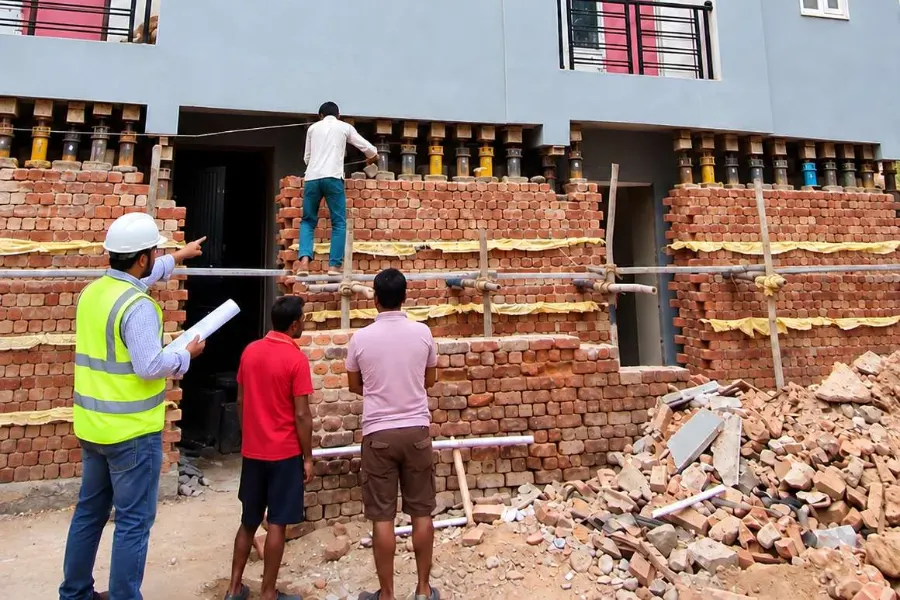
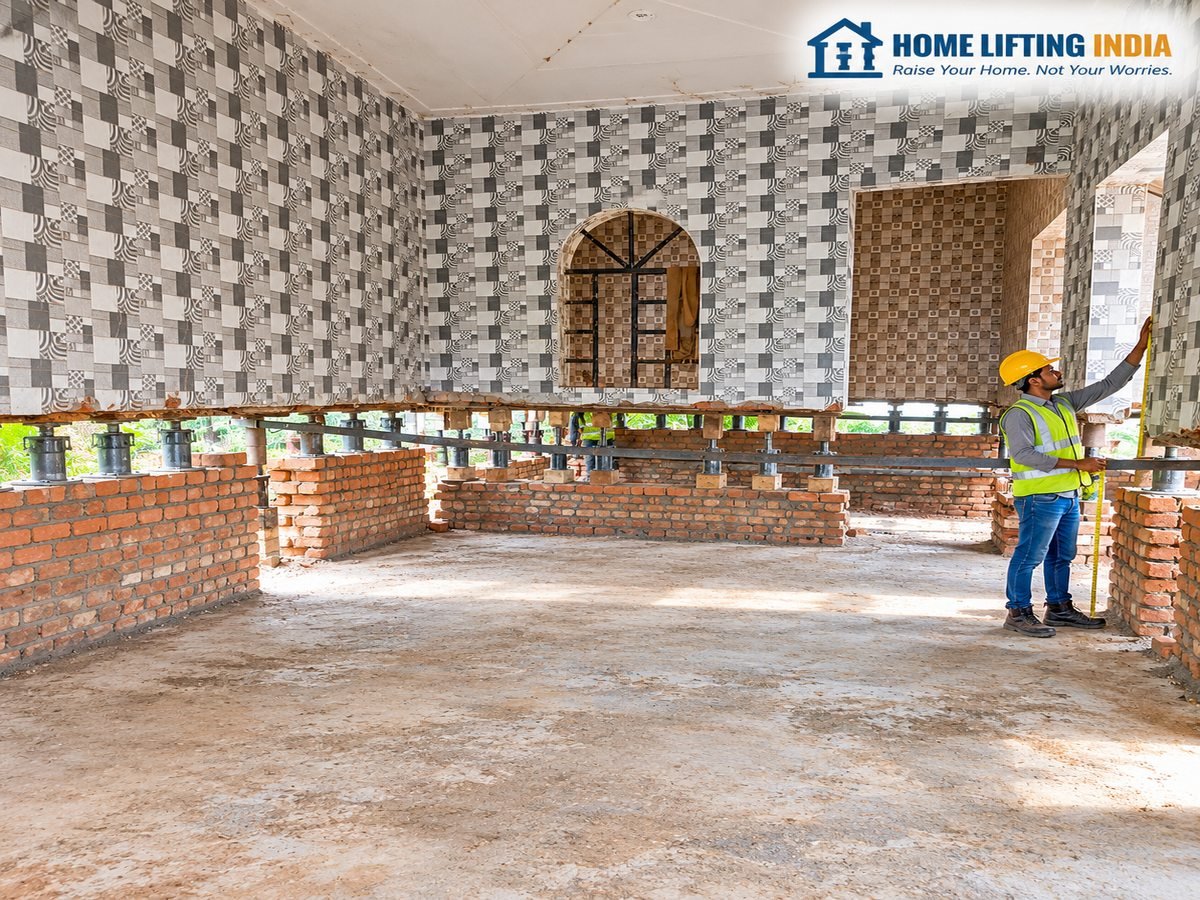
Jack Placement. Manual screw jacks are positioned at calculated load points under the building. The number of jacks depends on the building’s size and weight — a small house might need 20–30 jacks, a large building could need over 100.
Controlled Lifting. This is the main event. The jacks are turned simultaneously, raising the building millimetre by millimetre. The process is slow and deliberate. Our team continuously monitors levelness across the structure. This stage typically takes several days for a residential house.
Foundation Work. Once the building reaches the target height, we construct the new foundation or plinth underneath. This includes beam work, brickwork, and damp-proofing to ensure the new base is stronger than the original.
Final Inspection and Handover. Utilities are reconnected. The entire structure is inspected for levelness, cracks, and finish quality. We walk you through the completed work and hand over.
The full process for a typical residential house in Chennai takes 15–30 days depending on size and lift height. Multi-storey buildings take longer.
Want the detailed version with photos? Read our complete guide on the house lifting process.
Real Building Lifting Projects — Before and After
We don’t just talk about lifting buildings. Here are real projects completed by our team.
Project 1: Residential House Lifting in Chennai, Tamil Nadu
Problem: A 30-year-old residential house had sunk 2.5 feet below road level after repeated road resurfacing by the local body. Every monsoon, the ground floor flooded with 1–2 feet of water. The family had been living with this problem for over 8 years.
Solution: Lifted the entire G+1 house by 3 feet using manual screw jacks. Built a new reinforced foundation with damp-proofing.
Timeline: 22 days from start to handover.
Result: Zero cracks. The house now sits above road level with proper drainage gradient. No flooding since.
Project 2: Multi-Storey Building in Hyderabad, Telangana
Problem: A G+2 residential building was settling unevenly — one side had sunk 4 inches lower than the other, causing diagonal cracks across all floors. The foundation had weakened due to poor soil compaction during original construction.
Solution: Levelled the building first, then lifted it 2 feet and constructed a new, properly engineered foundation with deeper footings.
Timeline: 35 days.
Result: Building is now level and structurally sound. Cracks were repaired post-lifting. Occupants moved back within a week of completion.
Project 3: Temple Lifting in Ujjain, Madhya Pradesh
Problem: A 50+ year-old temple had gradually sunk below the surrounding road, causing water damage to the inner sanctum during rains. The trust wanted the temple preserved exactly as it was.
Solution: Used extra-slow manual screw jack lifting with additional support points around delicate stonework. Lifted 2.5 feet.
Timeline: 25 days.
Result: Temple lifted without a single crack or displacement of ornamental work. The trust received the structure in original condition, now safely above drainage level.
What our clients say:
“I had a 40-year-old ancestral house that needed lifting due to road level rise. Naveen Sir’s team used Manual Screw Jack Technology and lifted it 3 feet without a single crack. Highly recommended.” — Suresh Patel, Ahmedabad
“Naveen Sir answered every question on WhatsApp with photos and videos. The team completed our temple lifting in exactly 25 days as quoted. Complete transparency.” — Ramesh Yadav, Patna
“Our house was sinking on one side. Naveen Sir’s team leveled it perfectly using screw jacks, not a single crack appeared. Very professional and knowledgeable team.” — Kamlesh Vitthal, Maharashtra
Want results like these for your home? WhatsApp us your house photos and we’ll give you an honest assessment within 24 hours.
Why Choose Home Lifting India for Building Lifting in Chennai?
If you’re comparing building lifting services in Chennai, here’s what makes Home Lifting India different — and why it matters for your project.
20+ years of experience. We’ve been lifting buildings since before most companies in this space existed. That experience shows in how we handle complications — because there are always complications, and the team that’s seen them before handles them better.
5,000+ projects completed. Across 25+ states in India. Houses, apartments, commercial buildings, temples, godowns. We’ve lifted structures ranging from 500 sq ft to multi-storey complexes.
Manual screw jack specialists. This is our method, and it’s the safest method available. We didn’t adopt it because it’s easy — we adopted it because in 20 years of doing this work, we’ve seen what happens when buildings are lifted too fast with hydraulic equipment. Controlled, gradual lifting protects your home.
Led by civil engineers. Our founder Naveen Singh is a civil engineer, not just a contractor. That engineering-first approach means the numbers get done before the jacks go in. Structural assessment, load calculations, foundation design — it’s all engineered, not guessed.
Pan-India service with Chennai capability. Our head office is in Thane, Maharashtra, with a branch in Nilokheri, Haryana. We travel for projects across India, including Chennai and Tamil Nadu, with a team equipped to handle local soil conditions and climate.
Transparent pricing. No hidden charges. Our cost calculator gives you an indicative range before we even visit. The final quote comes after assessment, and it covers everything.
No-crack guarantee. We stand behind our work. When we assess a building and confirm it can be lifted, we guarantee the lift will be completed without structural cracks. That’s not a marketing line — it’s a commitment backed by our process and our track record.
Want to know more about the team and the company? Visit our About Us page.
Chennai Building Regulations and Permits for Lifting
Building lifting in Chennai is legal, but it’s not a free-for-all. There are rules, and following them protects you.
Do you need permission to lift a building in Chennai?
Yes. Before any lifting work begins, you’ll typically need to notify or obtain approval from the local body — the Chennai Corporation (Greater Chennai Corporation) or the relevant panchayat or municipality if you’re in the outskirts.
What you generally need:
Proof of property ownership (property tax receipt, sale deed, or patta)
Existing building plan (if available)
Application to the local body for structural modification
No-objection from immediate neighbours in some cases
Structural assessment report from a licensed civil engineer
CMDA norms to be aware of:
The Chennai Metropolitan Development Authority (CMDA) regulates building height, setbacks, and Floor Space Index (FSI). When you lift a building, you’re not adding floor area — but you are changing the plinth height. In most cases, this doesn’t violate CMDA norms because the building footprint and number of floors remain the same. However, if your building is already at the maximum allowed height, a lift could technically push it over the limit. This needs checking before work begins.
What Home Lifting India handles for you:
We don’t just show up with jacks. Our team helps you with the documentation process — the structural engineer’s report, the application to local authorities, and guidance on any permits needed. We’ve worked in enough states to know that every local body has its own process, and we factor this into the project timeline.
If your building’s foundation needs strengthening alongside the lift, we handle that engineering and documentation too.
One important note: Never hire a company that tells you permits aren’t needed. If a problem arises later — a property dispute, a sale, or a municipal inspection — undocumented structural modifications can create serious legal complications. Do it right from the start.
Frequently Asked Questions About Building Lifting in Chennai
How long does building lifting take in Chennai?
A typical single-storey residential house lifted through our house lifting services in Chennai takes 15–25 days. A G+1 or G+2 building takes 25–40 days. It depends on the built-up area, lift height, soil condition, and weather. We provide a timeline estimate before starting.
Will my tiles, wiring, and plumbing get damaged during lifting?
With manual screw jack technology, the lift is slow and even — which means internal finishes stay intact in the vast majority of cases. Tiles, electrical wiring, and plumbing connections are disconnected before lifting and reconnected after. Minor cosmetic touch-ups may be needed, but structural damage to interiors is extremely rare with our method.
Do I need to vacate the house during lifting?
Yes, for safety reasons. The building must be unoccupied while the jacks are active. You’ll need to stay elsewhere for the duration of the lifting phase (usually 10–15 days of the total project time). The preparation and finishing work before and after can often happen while you’re nearby.
Can you lift a 40–50 year old house?
Yes, provided the structural assessment clears it. Old houses are actually where our manual screw jack method shines — the slow, gentle lifting is exactly what an aged structure needs. We’ve successfully lifted houses built in the 1970s and 1980s without cracks.
Is building lifting legal in Chennai?
Absolutely. Building lifting is a recognised structural modification. You’ll need to notify or get approval from the Chennai Corporation or relevant local body. We assist with the documentation process.
How high can a building be lifted?
Up to 12 feet, depending on the structure. Most residential projects in Chennai need 2–4 feet of lift to get above road level. The lift height is determined during the engineering assessment.
Do you provide a warranty after lifting?
Yes. Every project under our building lifting services in Chennai comes with a no-crack guarantee. Once our team assesses and confirms a building is fit for lifting, we stand behind the quality of work. If any structural issue arises from our lifting process, we address it.
What if the soil condition is poor?
Chennai has varied soil — sandy near the coast, clayey inland, and marshy in low-lying areas. We test the soil before starting and adapt our foundation design accordingly. Poor soil means deeper footings, soil stabilisation, or alternative foundation methods. It’s factored into the plan and the quote.
Can commercial buildings and shops be lifted?
Yes. We’ve lifted shops, showrooms, godowns, and commercial complexes. The process is the same — the engineering just accounts for heavier loads and larger floor areas.
Is building lifting safe during monsoon season?
We prefer to schedule the actual lifting phase during dry weather. Rain doesn’t stop all work — preparation and finishing can continue — but the jacking phase ideally needs stable conditions. In Chennai, we typically plan projects to avoid the peak northeast monsoon months (October–December) for the lifting stage.
Get a Free Quote for Building Lifting in Chennai
If your house or building in Chennai is below road level, flooding every monsoon, or showing signs of foundation problems — don’t wait for the next monsoon to make it worse.
Here’s how to get started:
Talk to Our Engineers Today
We’ll assess your building honestly. If lifting is the right solution, we’ll tell you exactly what it will cost and how long it will take. If your building needs something else, we’ll tell you that too.
Home Lifting India — your trusted partner for building lifting services in Chennai. 20+ years of experience, 5,000+ projects, manual screw jack technology, and a team led by civil engineers. Safe, transparent, and built to last.
Home Lifting India provides building lifting, house lifting, house shifting, foundation strengthening, and stilt parking construction services across Chennai and all major cities in India. Head Office: Thane, Maharashtra. Branch Office: Nilokheri, Haryana.