
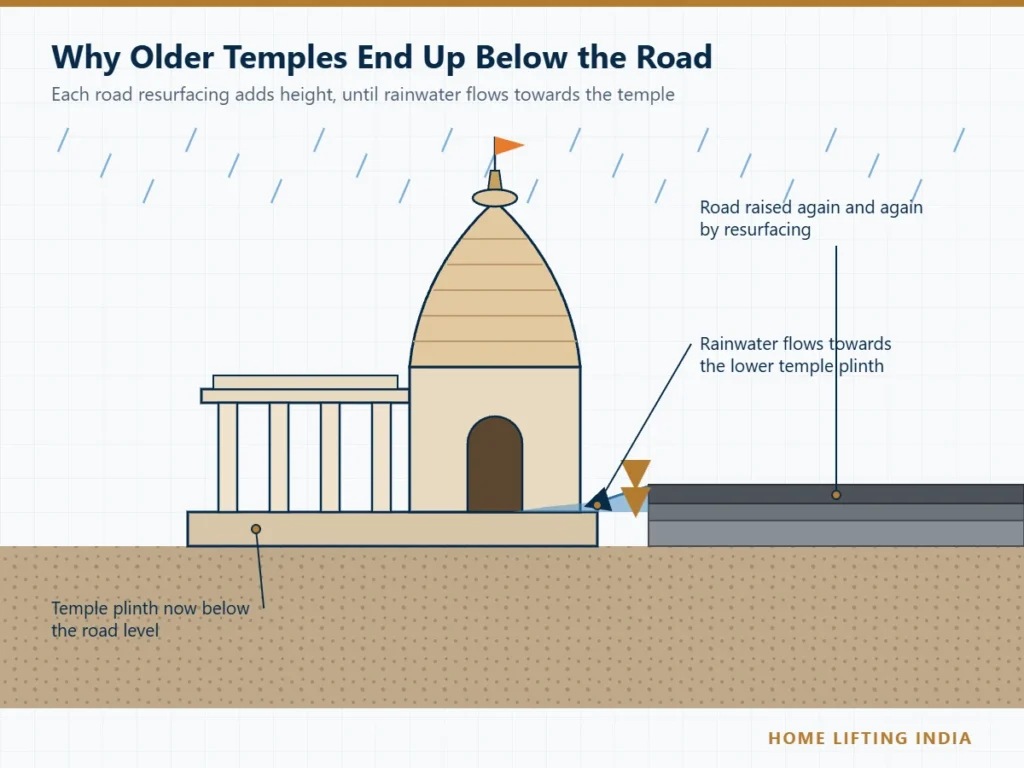
Walk through almost any old town and you’ll find one: a mandir that once sat level with the street and now sits below it. Devotees step down to get in. Every monsoon the steps fill with water, and someone spends the morning mopping out the mandap.
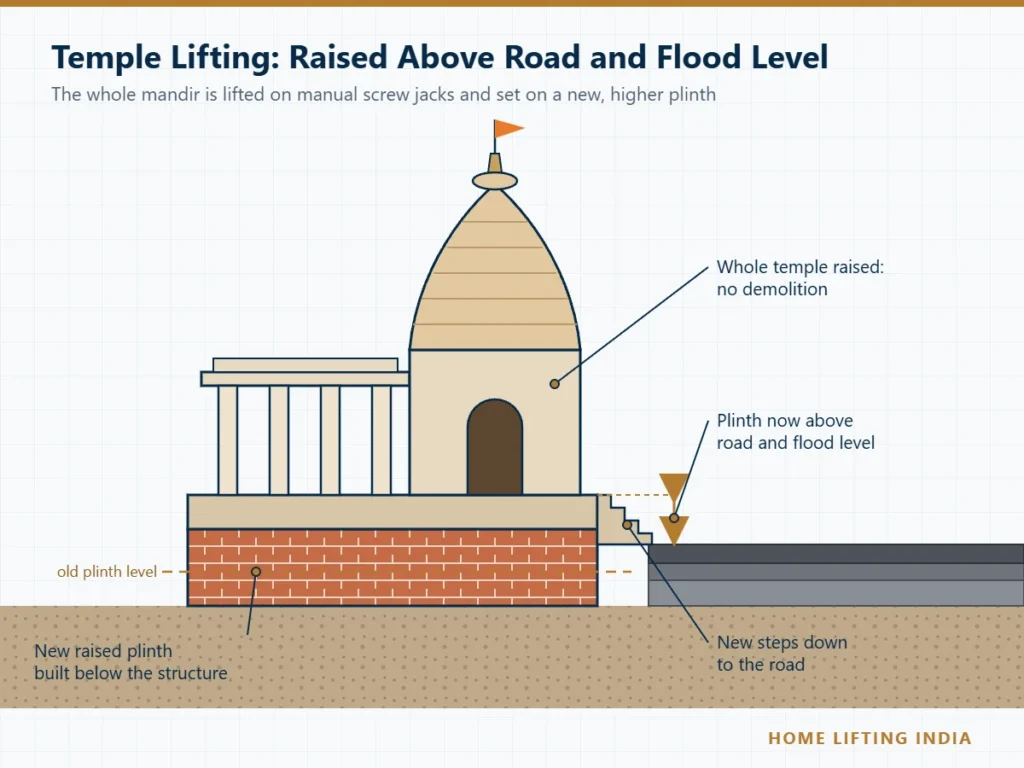
Temple lifting raises the whole mandir out of that dip, without demolishing anything. Home Lifting India does it with manual screw jacks, slowly, and with a lot of care for the murti, the stonework and the place itself.
We plan every temple lifting job together with the temple trust or committee. Our team was started by civil engineer Naveen Singh, and an engineer sees the temple before anyone agrees to anything.
Lift It or Rebuild It?
Breaking a temple your grandparents prayed in isn’t something any committee does lightly. With temple lifting, nothing people love about the old mandir is lost. It just ends up higher, out of the way of the road water. Rebuilding a mandir is a huge decision for any community, and lifting avoids having to make it.
How We Look After the Sanctum and the Carvings
If you’re on a temple committee, this is probably your first worry. Fair enough.
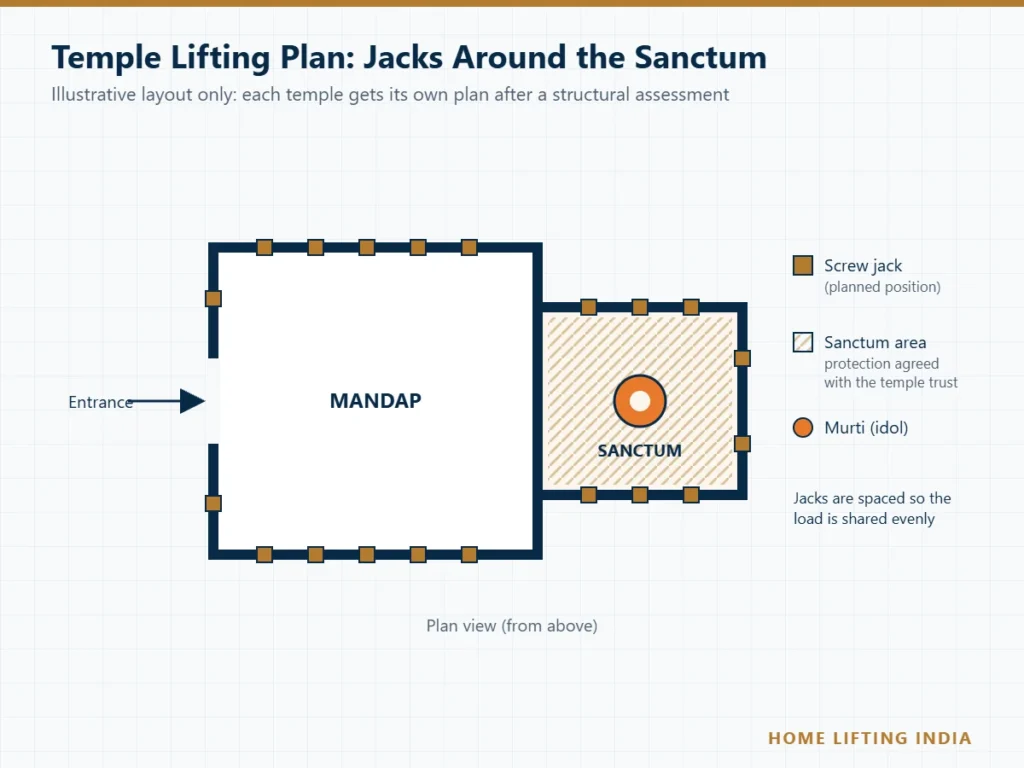
Before any work starts, we sit down with the trust and the priests and agree how the murti and the garbhagriha will be protected, and whether anything special needs to be done around them. Carvings, domes and the shikhar are checked and covered as part of the plan. The jacks go in at points chosen so the load is shared evenly, and the lift happens in small steps, which old masonry and stone handle far better than any sudden movement. We also plan the work dates around festivals and the important days in the temple calendar.
How Mandir and Temple Lifting Works
- Site visit. Layout, levels, access, and what’s around the temple.
- Structural and heritage check. How old is it, what’s it made of, and what shape are the walls, stone and foundation in?
- Sit down with the trust. We agree on how high to go, how the idols will be looked after, and dates that work for the temple.
- Covering up. Anything delicate is wrapped, and the lifting points are prepared.
- Jacks in. Manual screw jacks at planned spacing, so the weight is shared.
- The lift. A little at a time, with the levels watched constantly.
- New base, final check. Once the new plinth is done and everything’s been checked over, the temple goes back to the trust.

Can your temple be lifted, and how far? Honestly, we don’t know until we’ve done a structural assessment.
What About Just Raising the Floor?
Some committees think about just filling the floor inside and laying it higher. It’s cheaper at first. The trouble shows up later.
Inside, you lose height. People start ducking under doorways that were fine before, and the murti ends up closer to the ceiling than its builders ever meant it to be. And outside? Same old problem. The plinth is still below the road, so the water still comes.
Temple lifting moves the whole building up as one, and nobody touches the inside. It looks and feels like the same mandir because it is. It’s just sitting higher now.
Why Temple Trusts Come to Us
Old stone and brick don’t like being rushed. Screw jacks go slowly by nature, which is exactly why we use them for temple lifting. The company was founded by Naveen Singh, a civil engineer who still guides the team today, and twenty-plus years in, we’ve done more than 5000 projects.
We’re in Thane (Maharashtra) and Nilokheri, near Karnal (Haryana), and we travel for temple work wherever it is in India. The trust gets a clear quotation once we’ve seen the site.
“I found Home Lifting India through Google. Naveen Sir answered every question on WhatsApp with photos and videos. The team completed our temple lifting in exactly 25 days as quoted.”
Ramesh Yadav, Patna
Related Services
For community halls, dharamshalas and other big buildings, see building lifting. If the temple has settled or leans, house leveling and foundation strengthening can be done in the same project. Or browse all our services.
Temple Lifting FAQs
Often, yes. It depends on its age, what it’s built from, its condition and its foundation, and we check all of that before planning anything.
That depends on the temple and the plan. It’s decided with the trust and the priests before work starts, so the murti and the sanctum are protected properly.
Stone and brick temples can often be lifted after a careful check. The slow lift you get with screw jacks suits them well.
Size, construction, how high it goes and the protection work all affect the time. The trust gets a timeline after our site visit.
Depends on the temple and the stage of work. Darshan and puja arrangements are worked out with the trust and the priests before we begin.
There’s no fixed rate. The size of the temple, how it’s built, the lifting height, the foundation and the protection work all come into it. Send photos and details for a proper quote.
मंदिर के प्लिंथ के पास मैनुअल स्क्रू जैक लगाकर पूरे ढांचे को धीरे-धीरे, बराबर ऊपर उठाया जाता है। मूर्ति और गर्भगृह की सुरक्षा कैसे होगी, ये पहले ही मंदिर ट्रस्ट और पुजारियों के साथ तय कर लिया जाता है। आखिर में नया ऊँचा प्लिंथ और सीढ़ियाँ बनती हैं।
Want a rough cost first? Try the house lifting cost calculator.
Get a Free Temple Lifting Quote
Send the temple’s location, a few photos, its rough size and how high it needs to go. We’ll guide the trust on what happens next.