
House lifting by jack sounds like a stunt from a video reel. A whole house sitting on rows of small steel jacks, going up a few millimetres at a time.
It isn’t a stunt. It’s how sunken houses across India get back above the road without being knocked down. Done properly, it’s slow and boring to watch, and that’s exactly how you want it.
What you won’t find online is a straight explanation. Search for it and you get jacks for sale, 30-second clips, and contractors promising “100% safe”. None of that tells you what matters when it’s your own house going up: which jacks, how many, who turns them, and when a house shouldn’t be lifted at all.
That’s what this guide covers. We’re Home Lifting India, and manual screw jacks are the only thing we lift with. So yes, we have a view. We’ll explain where hydraulic jacks fit as well.
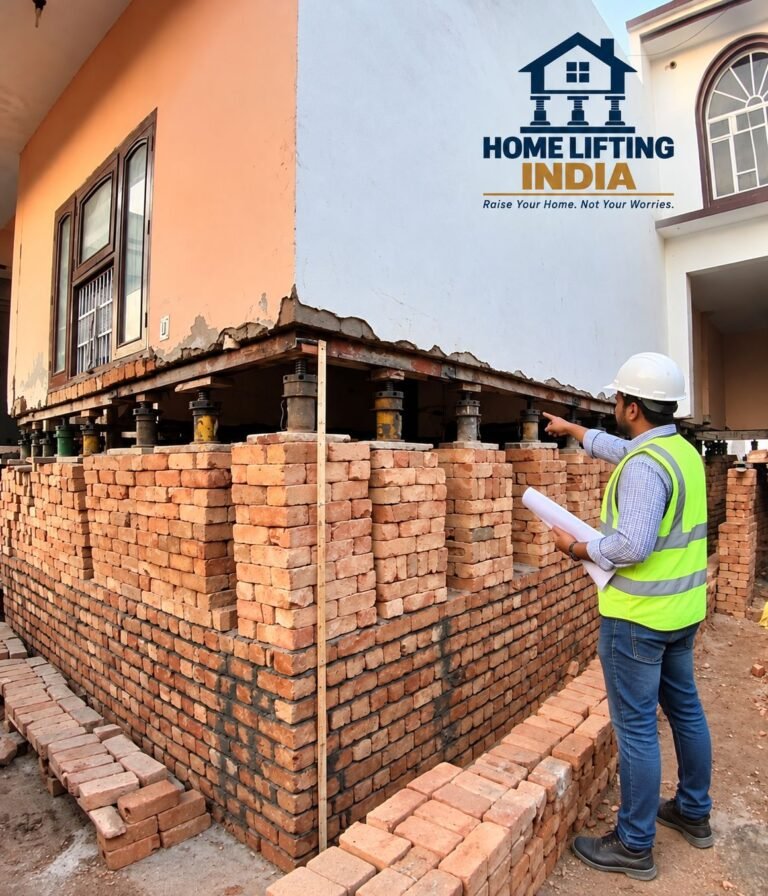
The short answer. The house is freed at plinth level and jacks go in under the walls, at points the engineer has marked out. Then the crew turns them, a little each, same order every round, and bricks or packing get stacked below as the gap opens. At the new height a fresh plinth goes in and the jacks come out. Most Indian crews (us included) use manual screw jacks for this, because they stay put on their own. Hydraulic jacks work too, but oil can bleed off overnight, so they need a locking collar or packing under them.
How House Lifting by Jack Works (in Plain Words)
Think of it as moving the weight of your house from the old foundation onto jacks, raising it, then moving the weight back onto something new.
The rough order on site:
- Assessment. Someone qualified looks at how the house is built, what shape it’s in, the soil, the drains and the lane.
- Preparation at plinth level. Earth is dug out along the walls where needed. Water, drain and electric lines through the plinth are disconnected or adjusted.
- Jacks go in. They sit at planned points so every wall carries its share.
- Lifting. A small turn on each jack, in a fixed order. Levels checked again and again. Supports stacked under the house as it rises.
- New base. At the final height the gap becomes a new plinth, or new foundation work goes in where it’s needed.
- Load transfer and finishing. Weight moves onto the new base, the jacks come out, and steps, entrance and services are rebuilt at the new level.
That’s the skeleton. We’ve written the full version, with what happens to your plumbing and how long each stage takes, in our house lifting process guide. Here we’re going to stay on the jacks, because that’s where most of the confusion is.
Screw Jack vs Hydraulic Jack: What's the Real Difference?
Both can lift a house. What’s different is how they hold it once it’s up, and honestly that matters more than raw lifting power.
A screw jack is basically a fat steel bolt turning inside a nut. Turn the handle and the screw climbs. Stop turning and it stays put, because the friction in the thread won’t let it slide back down on its own. Engineers call this self-locking. There’s no oil, no pump, no pressure to lose.
A hydraulic jack pushes a ram up with oil under pressure. It’s fast and very strong for its size. But it’s holding the load with that pressure, and seals can let it creep down slowly over time. That’s why drift on hydraulic lifting equipment has to be stopped mechanically, with locking collars, safety stands or packing. Good hydraulic crews do exactly that.
| Manual screw jack | Hydraulic jack | |
|---|---|---|
| How it holds the load | Thread friction, mechanically | Oil pressure, plus locks or packing |
| Left overnight | Stays where it was | Can creep unless locked or packed |
| Power cut on site | Makes no difference | Powered pumps stop; hand pumps don’t |
| Speed | Slow, small turns | Fast |
| Fine control of level | Very fine, turn by turn | Good, needs care or a synchronised system |
| Where you’ll mostly see it | Indian load-bearing houses, lifted over days | Fast lifts, heavy structures, synchronised systems abroad |
So is hydraulic “unsafe”? No. A well-run hydraulic job with proper locks and a synchronised system can be done safely, and plenty of heavy structures are lifted that way.
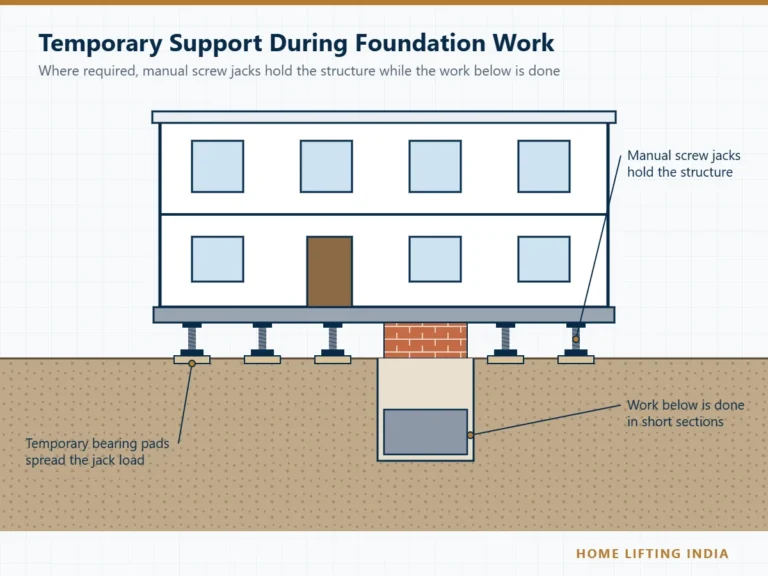
For our own house lifting by jack, we stick to screw jacks for a plainer reason. A typical Indian house is lifted over days, not hours. It spends nights and rest days sitting on jacks. We’d rather it sat on something that holds by itself than on something that has to be watched. And the slowness helps. Small turns make it easier to keep a brick house level the whole way up, which is what protects the walls.
One of our clients put it in his own words:
“I had a 40-year-old ancestral house that needed lifting due to road level rise. Naveen Sir’s team used Manual Screw Jack Technology and lifted it 3 feet without a single crack.”
Suresh Patel, Ahmedabad
How Many Jacks Does a House Need?
Ask most people to picture house lifting by jack and they expect a number like eight. One at each corner, a few in the middle.
It’s far more than that, and there’s no single figure, because the count comes from the house, not a rule of thumb. Roughly, the engineer works it out like this:
- First, the weight. Even a small one-floor brick house with an RCC slab comes to well over a hundred tonnes (people never believe this), and a second floor adds plenty.
- Where it comes down. Along the walls in a load-bearing house. Mostly through the columns in a framed one.
- What each jack can safely carry, with a margin kept back.
- And the one people forget: how close the jacks have to sit so the wall above doesn’t sag between them.
That last point is the one that surprises people. Even if a few big jacks could carry the total weight, a brick wall isn’t a steel beam. Spread the support too far apart and the wall starts bending between the points. So jacks go in close together, all along the walls, and the count adds up quickly.
If a contractor gives you a jack count over the phone, before anyone has looked at the house, treat it as a guess.
Can You Lift Your House Yourself With Rented Jacks?
We get asked this. Jacks are on rent in most towns, and the videos make it look simple.
Please don’t.
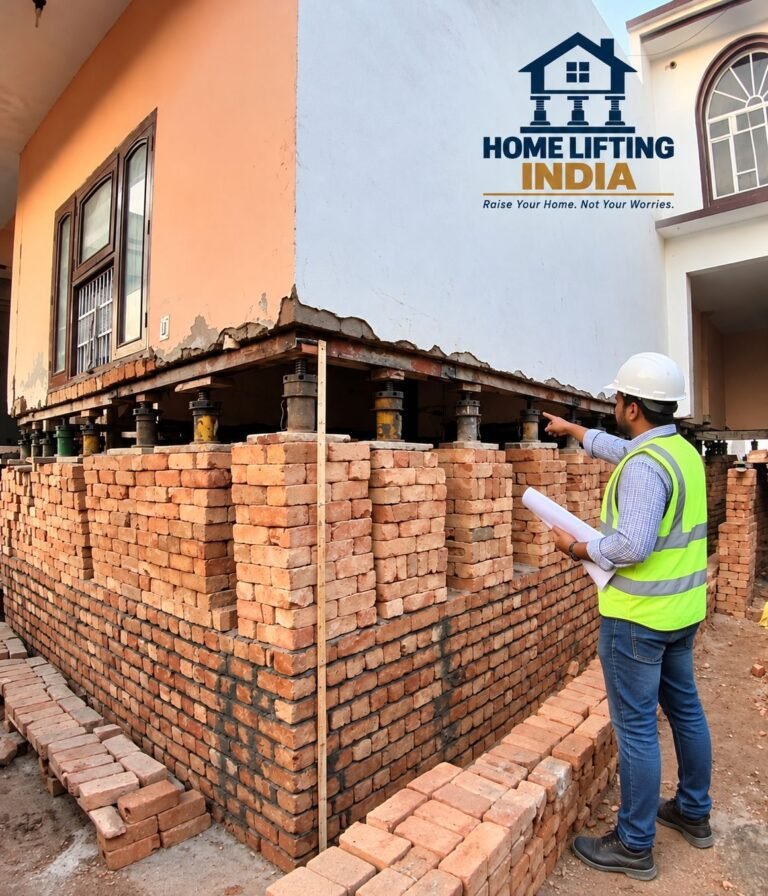
The jacks are the easy part. The hard part is knowing whether your walls, beams and foundation can take being lifted at all, where every jack has to sit, what goes under each one so it doesn’t punch into the soil, and how to keep the whole building rising evenly. Get any of that wrong and the damage isn’t a cracked tile. It’s a cracked wall, a dropped slab, or worse, with your family’s home on top of it.
Money tight? Fair enough. Have someone look at the house before you spend a rupee. Our visit is free, and at least you’ll know whether lifting makes sense for your place.
When a House Shouldn't Be Lifted by Jack
Lots of houses can be lifted. Not all.
In 2025 the Building Materials and Technology Promotion Council (BMTPC), under the Ministry of Housing and Urban Affairs, issued a Performance Appraisal Certificate for a screw-jack building lifting technique. It was issued to another firm, not to us, but the conditions in it are sensible for anyone doing this work. It says the building has to be checked by a competent structural engineer before lifting, and the work done by trained people under qualified engineers. It also lists situations where lifting isn’t done:
- marshy land
- buildings right next to drains, sewers or ponds
- places with high-voltage lines overhead
- RCC slabs that leak
- houses with stone-tile roofs resting on joists instead of an RCC roof
On top of that, any honest assessment will look hard at deep structural cracks, a house that’s already tilting, very weak old foundations and tight access for men and material. Some of these can be fixed first. A tilting house, for example, usually needs leveling, and a weak base may need foundation strengthening while the house is up anyway. Some can’t, and then the honest answer is “don’t lift”.
Not sure which side your house falls on? Send a few photos on WhatsApp to +91-8168700086 (the house, the road and the entrance) and we’ll tell you whether lifting looks sensible.
Does Lifting a House by Jack Crack the Walls?
It can, if it’s rushed or uneven. That’s the honest answer.
Cracks usually come from one part of the house going up faster than the rest. The wall is being asked to bend, and brick doesn’t like bending. That’s why the work is done in small turns, in a fixed order, with levels checked all the time, and why temporary supports go in as the house rises.
Hairline cracks in the old plaster? You might get a couple. Lots of old houses have them before we even start (look near the window corners), and the mistri patches them during finishing. But if someone promises you zero risk, walk away. Either they haven’t thought about it or they’re not being honest. Risk depends on the building, the soil, the equipment, the lifting sequence and the people doing it. Ask any contractor what they’ll do to keep the lift even, and what happens if a crack does appear.
How High Can a House Be Lifted With Jacks?
Higher than most people think, but the engineer sets the limit, not the jack.
Jacks are raised in stages, with packing added underneath, so the height isn’t limited by how far one jack can travel. What really decides it is the building’s condition, the soil, and what’s practical for the new plinth, steps and entrance. More height also means more stages, more support work and more days, which shows up in the cost.
For most families the question is simpler: how high does the floor need to be to stay clear of the road and the monsoon water for the next 20 years? If that’s where you’re stuck, our guide on houses below road level walks through how to decide.
What Does House Lifting by Jack Cost in India?
We don’t publish rates, because two houses of the same size can need very different work. What drives the cost:
- built-up area of all floors combined
- how many feet the house has to go up
- the building’s construction and condition
- foundation work needed under the new plinth
- site access, and how far material and jacks have to travel
For a budget figure, try our house lifting cost calculator. For a real number, you need a site assessment and a written quotation.
Want to Know if Your House Can Be Lifted?
Send a few photos of the house, the road and the entrance on WhatsApp, or give us a call. Free quote, no obligation.
8 Questions to Ask Any Contractor About Their Jacks
Whoever you hire for house lifting by jack, ask these. A good contractor will answer every one without getting annoyed.
- What kind of jacks will you use, and how do they hold height overnight? Screw jacks hold by themselves. With hydraulic, ask about locks and packing.
- How many jacks, and where? The answer should come after a site visit, not before.
- What goes under each jack? Jacks need a firm bearing, or they sink into the soil.
- Who turns them, and how is the level checked? You want a fixed sequence and frequent checks, not “the boys know”.
- Has an engineer checked my building? Ask who, and what they looked at.
- What happens if work has to stop? Rain, a festival, a material delay. How is the house supported in the meantime?
- Who reconnects water, drains and wiring at the new level?
- Will I get a written quotation based on area and lifting height, with what’s included spelled out?
If a contractor’s main pitch is “100% safe, guaranteed”, be careful. Nobody who does this properly talks like that.
Why Families Call Home Lifting India
House lifting is all we do, along with the jobs that come with it: house shifting, leveling and foundation work. Naveen Singh, a civil engineer, started the company and still guides the team. We’ve been at it for 20+ years and finished 5000+ projects across 25+ states, from single-storey homes to a building alignment for UltraTech Cement. Our head office is in Thane, Maharashtra, with a branch in Nilokheri near Karnal, Haryana.
Every job is done with manual screw jacks, slowly and in sequence, after the building has been assessed. If you’d like the full picture of what we do, start with our house lifting services. For apartments and taller buildings, see building lifting.

Get Your House Checked Before the Next Monsoon
Concrete for a new plinth needs dry weather to cure, so the months after the rains are the best time to plan. Send us photos of your house and the road, and we’ll tell you honestly whether house lifting by jack is right for you.
House Lifting by Jack: Questions We Get Asked
Mostly manual screw jacks, turned by hand. Once turned, a screw jack doesn’t slip back, so the house can sit on it overnight. You’ll see hydraulic jacks on some sites too. Quicker, yes, but they need a locking collar or packing under them, or the oil slowly lets them sink.
There’s no fixed number. It depends on the weight of the building, where that weight comes down, the capacity of each jack and how close they must be so the walls don’t bend between them. For an ordinary house it’s far more than people expect. A real count needs a site visit.
It can be done safely when the building is checked by a competent engineer first, the jacks sit on firm bearing, and the lift is slow and even with supports going in as it rises. Some houses shouldn’t be lifted at all, for example on marshy land or right beside a drain. No honest contractor will call it risk-free.
We’d strongly advise against it. Turning the jacks is the easy bit. The risk is in judging whether the structure can take the lift at all, where each jack goes, and keeping the house level as it rises. Get that wrong and walls crack or a slab drops. Have the house looked at before anything else.
It matters less than who’s running the job, to be honest. We prefer screw jacks because a house sits on them for days, and a screw jack holds without anyone watching it. It’s also easy to give one a tiny turn when a corner is a few mm behind. Hydraulic is quicker, but it holds on oil pressure, so it needs mechanical locks. We use manual screw jacks only.
If they happen, it’s usually because one side went up ahead of the other. That’s why each jack gets a small turn in a fixed order and the level is checked all the time. Some hairline cracking in old plaster is possible. It gets patched during finishing.
It depends on the built-up area of all floors, the lifting height, the building’s condition, foundation work and site access. Use the house lifting cost calculator for a budget figure, then get a written quote after a site assessment.
Planning to lift your house? Talk to us first.