
Usually it starts with a door. One that shut fine for years now scrapes the floor, or won’t latch at all. A slanted crack near a window turns up around the same time. Together, those two point to one thing: part of the house has sunk. Putting that right is what house leveling is for.
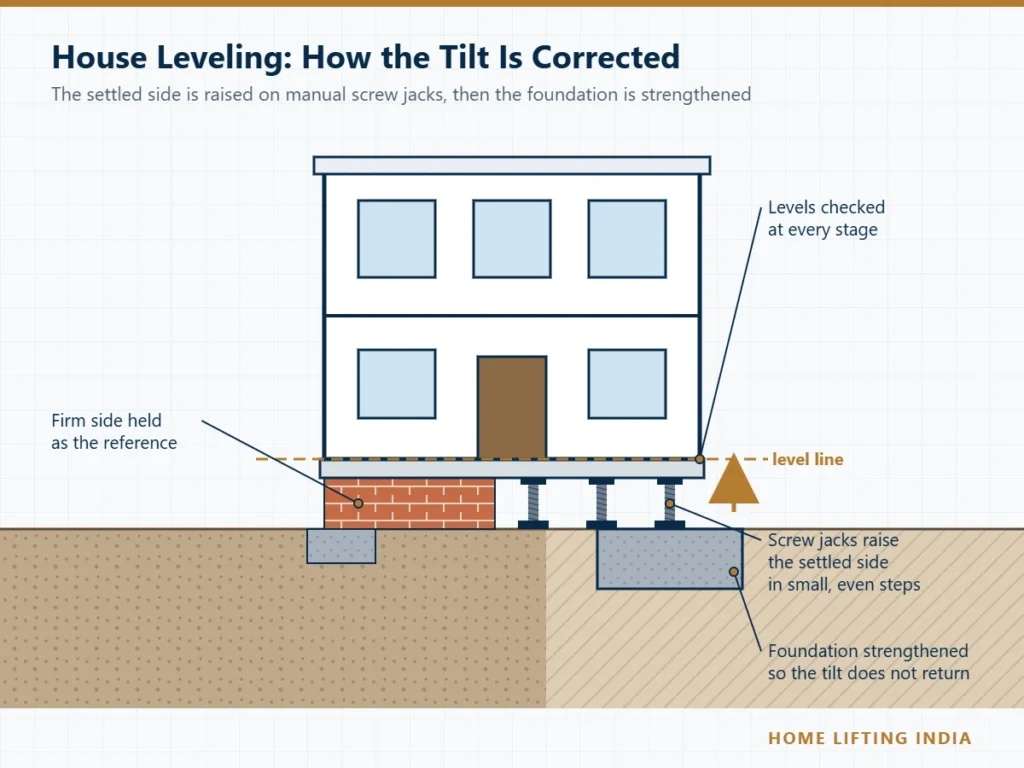
Some people write it house levelling, some call it tilted building correction. Same job. We find the side that has sunk, raise it slowly on manual screw jacks until the building sits level again, and then sort out the foundation so it doesn’t drift back.
It really is engineering work, not just jacking. Our team, started by civil engineer Naveen Singh, first works out why the building moved. The fix depends on that answer.
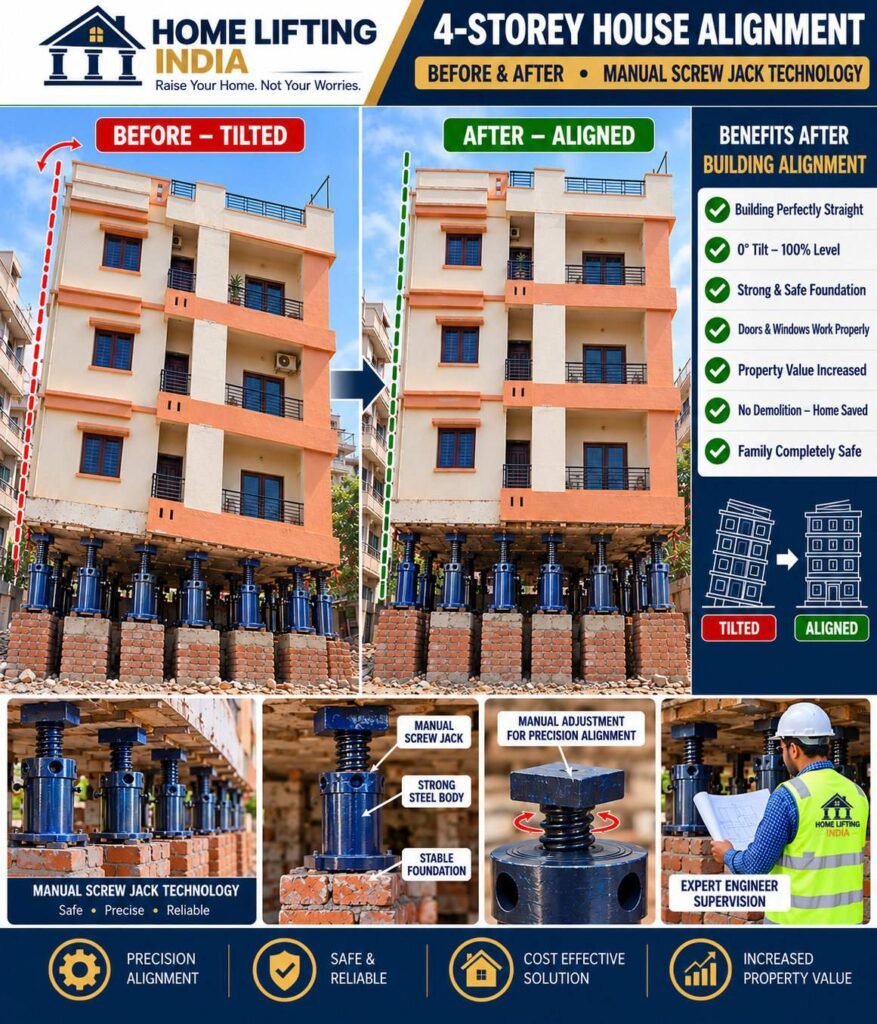
Signs Your House Needs Leveling
Watch for these:
- cracks that run at an angle, usually out of the corners of doors and windows
- a door you now have to lift or shove to close
- a floor with a visible slope, or a gap opening between the floor tiles and the wall
- your building leaning a touch compared with the one next to it
- rainwater that always pools on the same side of the floor or terrace
Growing cracks, or a lean you can actually see? Don’t sit on it. The earlier this gets looked at, the smaller the job usually is.
Quick Checks You Can Do at Home
None of these replace a proper level survey. They’re just a way to know whether you should be worried.
Marble test: roll one in two or three rooms. If it always runs to the same wall, that floor isn’t flat. Got a spirit level? Even a cheap one from the hardware shop will do. Rest it on a window sill or the kitchen slab and watch the bubble. For walls, the old mistri method still works: a small weight on a thread, held next to a corner. If the wall and the thread don’t run together, something has moved.
Then the pencil trick for cracks. Mark both ends, write the date beside it, and check again after a few weeks. If the crack has gone past your marks, the building is still on the move.
Worried after that? WhatsApp us the photos. Before any house leveling, our level survey measures exactly how far things have moved, and which corner went down.
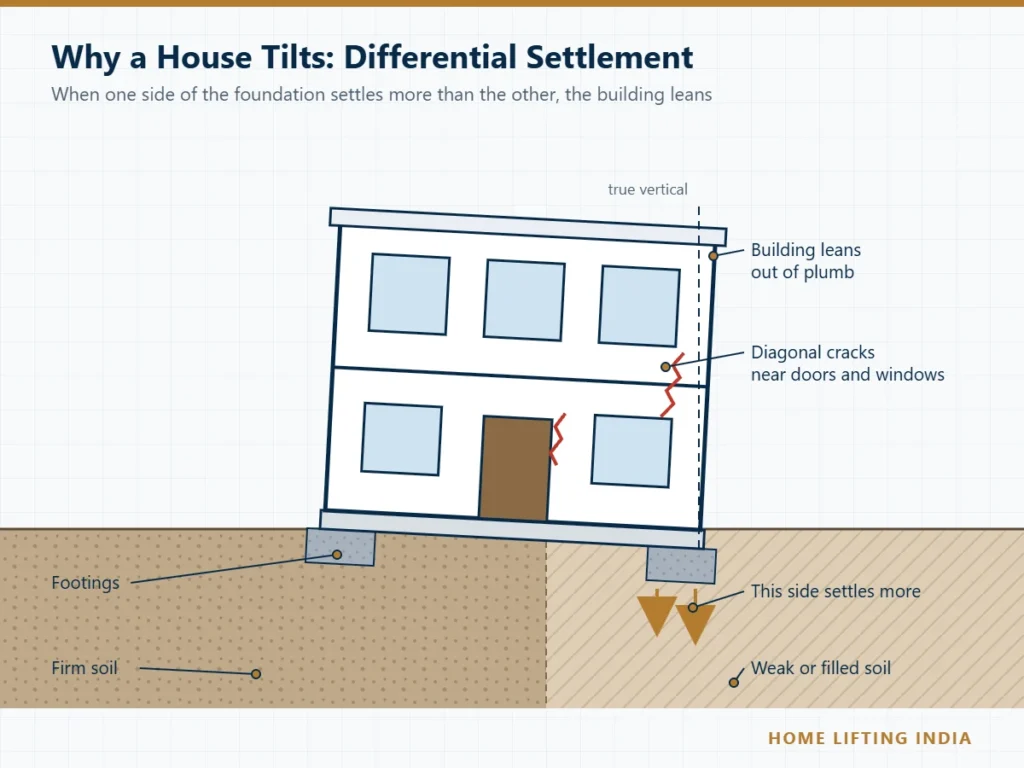
Why Do Houses Tilt or Sink?
In most cases the trouble is the ground under the house, not the house itself. One part of the foundation settles more than the rest. Filled-up land and soft clay are the usual suspects, and water makes it worse: a pipe that’s been leaking for months, a drain overflowing next to the wall, a water table that comes up every monsoon.
Then there’s the neighbour who digs a deep foundation right against your wall. And now and then, the footing was just too small for the house from the start.
How We Do House Leveling
- Level survey. We measure how much it has tilted or settled, and where.
- Find the cause. Soil, water, the foundation, or work next door?
- Structural check. Walls, columns and the foundation are looked at before we plan anything.
- Plan. Jack positions are fixed, and we work out how far each part has to come up.
- Lift the low side. Manual screw jacks raise the settled side bit by bit, with levels taken at every stage.
- Strengthen the base. The foundation is made stronger so the building stays where we put it.
- Final levels. We take readings one last time, then hand the house back to you.
House Leveling or Just Fixing the Cracks?
You can fill the cracks and repaint. It’ll look fine for a season or two. But if one side of the foundation has dropped, the stress is still there, and the cracks open up again, usually in the same spots.
House leveling fixes the position of the building itself, and the foundation work takes care of why it moved. Repairs done after that actually stay done. The other option is to demolish and rebuild, which costs you a whole new house when the old one might be perfectly good once it’s straight.
“Our house was sinking on one side. Naveen Sir’s team leveled it perfectly using screw jacks, not a single crack appeared.”
Kamlesh Vitthal, Maharashtra
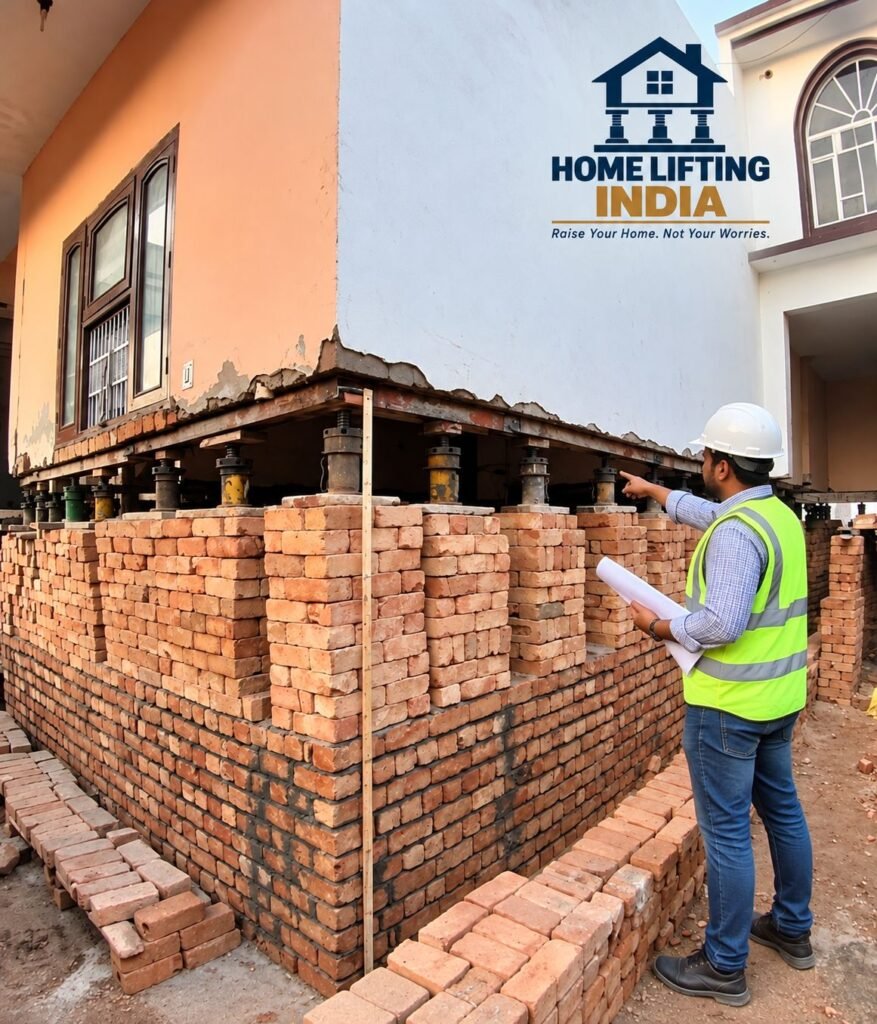
Why People Choose Us for House Leveling
Screw jacks let us make very small adjustments, and leveling is all about small adjustments. Our team was founded by civil engineer Naveen Singh, has 20+ years in this work and 5000+ projects behind it, and one of our landmark jobs was a building alignment for UltraTech Cement.
“We are a commercial builder and needed a G+3 apartment building aligned due to uneven settlement. Home Lifting India handled the entire project with proper planning and documentation.”
Gurpreet Kaur, Ludhiana
We’re based in Thane, Maharashtra, with a branch in Nilokheri near Karnal in Haryana, and we take on leveling work all over India.
Related Services
Leveling and foundation strengthening often go hand in hand, since a weak footing is usually what caused the tilt. If the whole building also needs to go higher, look at house lifting and building lifting. Or see all our services.
House Leveling FAQs
Yes, quite often. The settled side is raised slowly until the building is level again. Whether yours can be done depends on how it’s built, its condition and its foundation, which we check first.
Uneven settlement of the foundation, mostly. Soft or filled soil, water from leaks or bad drainage, deep digging next door, or a footing that was undersized to begin with.
Leveling puts the building back in position and takes the stress off the walls. Cracks that are already there still need to be repaired and finished, and we’ll tell you what’s in the quote.
It can be, after a structural check. Screw jacks raise the low side slowly, which suits older buildings, but the walls and the foundation decide what’s possible. If yours isn’t a good candidate, we’ll say so.
It depends on the size of the building, how much it has tilted, the cause and the foundation work needed. You’ll get a timeline after the level survey.
There’s no fixed rate. The size of the building, the floors, how far it has moved, the cause and the foundation work all affect it. Send us photos of the cracks and the lean for a proper quote.
पहले लेवल सर्वे से देखा जाता है कि मकान कितना और क्यों झुका है। फिर मैनुअल स्क्रू जैक से धंसे हुए हिस्से को थोड़ा-थोड़ा ऊपर उठाकर मकान सीधा किया जाता है, और नींव मज़बूत की जाती है ताकि मकान दोबारा न झुके। ये सब स्ट्रक्चर की जांच के बाद ही तय होता है।
Want a rough cost first? Try the house lifting cost calculator.
Is Your House Tilted? Get a Free House Leveling Quote
Send us photos of the cracks and the lean, your location and the number of floors. We’ll tell you what the next step should be.